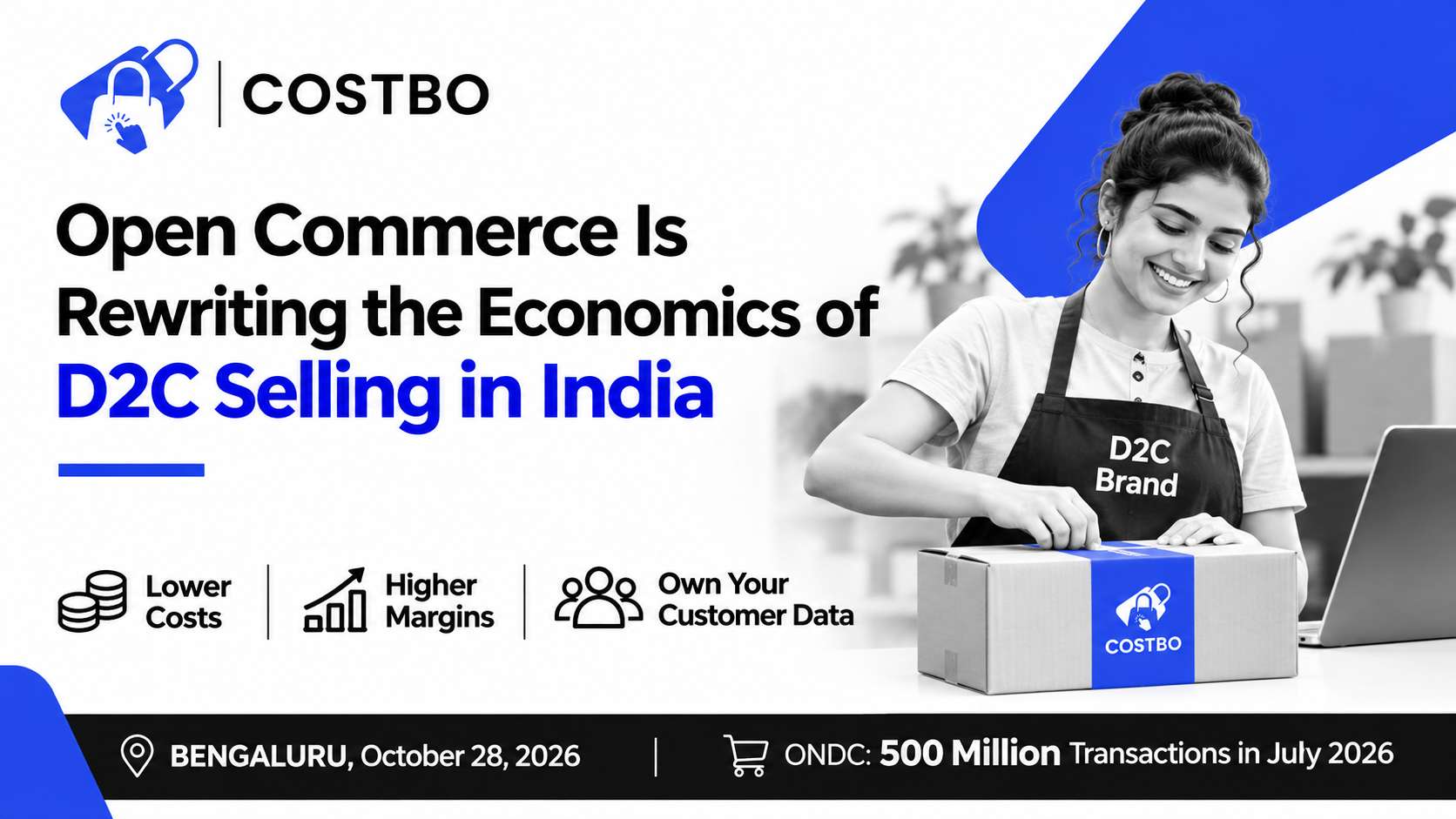
BENGALURU, November 25, 2026 — India's D2C e-commerce market is expected to be worth USD 108.8 billion in 2026 and grow to USD 322.1 billion by 2031, according to Mordor Intelligence. But for most of the last ten years, Indian D2C brands had only two choices. They could build their own website and work hard for every visitor, or they could sell on a big marketplace and give away a quarter to a third of every sale. Open commerce, led by the Open Network for Digital Commerce (ONDC), now gives them a third choice. With the right support, this choice is changing how much brands earn from selling online.
What Sellers Expect Today
There is a reason why so many brands still sell on big marketplaces. Over the years, sellers have come to depend on a set of basic services: business listings, good product catalogues, stock management across their own website and other channels, multiple warehouses, pickup and delivery through logistics partners, returns and exchanges, and payments and settlements.
Then there is the biggest challenge of all: marketing across many channels. Most D2C brands and online sellers do not have teams to help customers find them on social media, buyer apps, affiliate networks and, more and more, AI assistants.
Until now, only big marketplaces have offered all of this in one place. Because of this, sellers now expect these services from any online sales channel they use.
The Price of Convenience
But this convenience is expensive. Commission is only the starting point. Fixed fees, collection charges, shipping, return shipping and 18% GST all add to the total cost.
Analysts at Jefferies estimated that Amazon takes 32% of the price of a women's ethnic-wear item priced below ₹500, while Flipkart takes 23%. Across categories, total marketplace costs are usually between 18% and 28% of the selling price.
And this does not include advertising. Brands often have to pay to show up in search results for their own brand names, and the marketplace, not the brand, owns the customer relationship. The marketplace earns from high seller charges, and the seller pays the price. This is why many sellers are now looking at open commerce.
The Challenge with Moving to Open Commerce
But moving to open commerce is not as simple as adding a new sales channel. When sellers join ONDC, they expect the same services that big marketplaces give them. They see ONDC as just another marketplace, one that offers better returns. But ONDC, like UPI, is a set of rules for how systems connect. It is not a company that runs the business. It does not run warehouses, manage product catalogues or work with delivery partners.
So an important question comes up: how can every seller on an open network get marketplace-level services from the first day? Who will handle the technical setup, manage product listings, deliver orders to customers and help with marketing?
How Costbo Solved This for Hundreds of Leading D2C Brands
This is the problem Costbo set out to solve. Costbo is a Bengaluru-based ONDC seller platform and intercity logistics company. It built marketplace-level systems for open commerce from scratch, covering both operations and marketing. The model works: Costbo has processed, delivered and settled more than one million orders.
From the start, the Costbo team knew that accurate catalogues, stock management, back-office work and full delivery support were needed to run online selling well at a large scale. Building all this took hard work, deep business knowledge and the focus to create products that could do more than the big marketplaces.
The platform also had to follow the Beckn protocol, the open standard behind ONDC, so that every partner on the network could take part.
Today, Costbo offers sellers the following services free of cost:
● Full onboarding and first orders within 2 to 24 hours.
● Low-cost delivery across India and within cities, with last-mile tracking and delivery reports.
● Stock and order management that connects in minutes with Uniware, EasyEcom, Increff and other leading tools.
● Product catalogues that reach social media, buyer apps, Google Merchant Center, AI assistants (LLMs) and affiliate networks, with simple back-end support.
● Handling of returns and undelivered orders (RTO).
● A system to handle customer complaints and issues.
● Launch offers, free gifts and promotions, fully tracked with UTM links.
● An AI-powered system for business reports and decision-making.
● A CRM that shows customer buying patterns, demand by location and sales forecasts.
● Fully automatic payments, reports and settlements, including profit and loss (P&L) data.
With these services, brands can start selling on ONDC in a few easy steps. That leaves the hardest part for most sellers: helping customers find them.
Marketing and Sales Made Simpler
Costbo solves this with a pay-per-sale model. Brands pay for marketing only when a sale happens. This makes marketing simpler and much less risky for brands.
"Sellers don't understand the protocol. They want a channel that works just like a top-tier marketplace and delivers better economics," said Priya Ramachandran, CIO (Ex-Google, USA), Costbo. "Accurate catalogues, real-time inventory and reliable logistics aren't just features. They're the foundation."
Brand Value, Data and Fairer Prices
Getting operations and marketing right is only the first step. The bigger benefit is what open commerce gives brands that big marketplaces often do not: better returns, control over their own customer data and, most importantly, the chance to build their brand.
On the open network, brands can see who bought what and from where. Their products appear under their own brand names, not as just another small box on a crowded marketplace page.
With systems like the ones Costbo has built, the numbers change. By removing middlemen, brands can earn more and offer lower prices to customers.
"For years, the intermediary layer in a transaction has been its most expensive part. Open commerce allows brands to retain more of what they earn and build something they truly own," said Mr Eswar, Founder & CEO, Costbo.
What's in It for Consumers?
Customers gain too. When they buy directly from sellers and brands, they get lower prices, more choice and, in many cases, products that come straight from the factory.
Just as UPI made digital payments easy for everyone, open commerce can give customers good-quality products at fair prices directly from sellers, along with better support.
This change has already started. ONDC crossed 500 million transactions in July 2026, five years after it was launched. As more people use it, brands that join early with strong support will be in the best position to turn open commerce from a test channel into a main source of profit, and to share the benefits with their customers.
About Costbo
Costbo Services Pvt. Ltd. was founded in 2017 and is based in Bengaluru. It is an ONDC seller platform for D2C brands, FMCG companies, manufacturers, distributors and online sellers.
Media Contact
Abhay Kumar
Email: abhay@marketingadvisor.in
Phone: +91 80996 11325