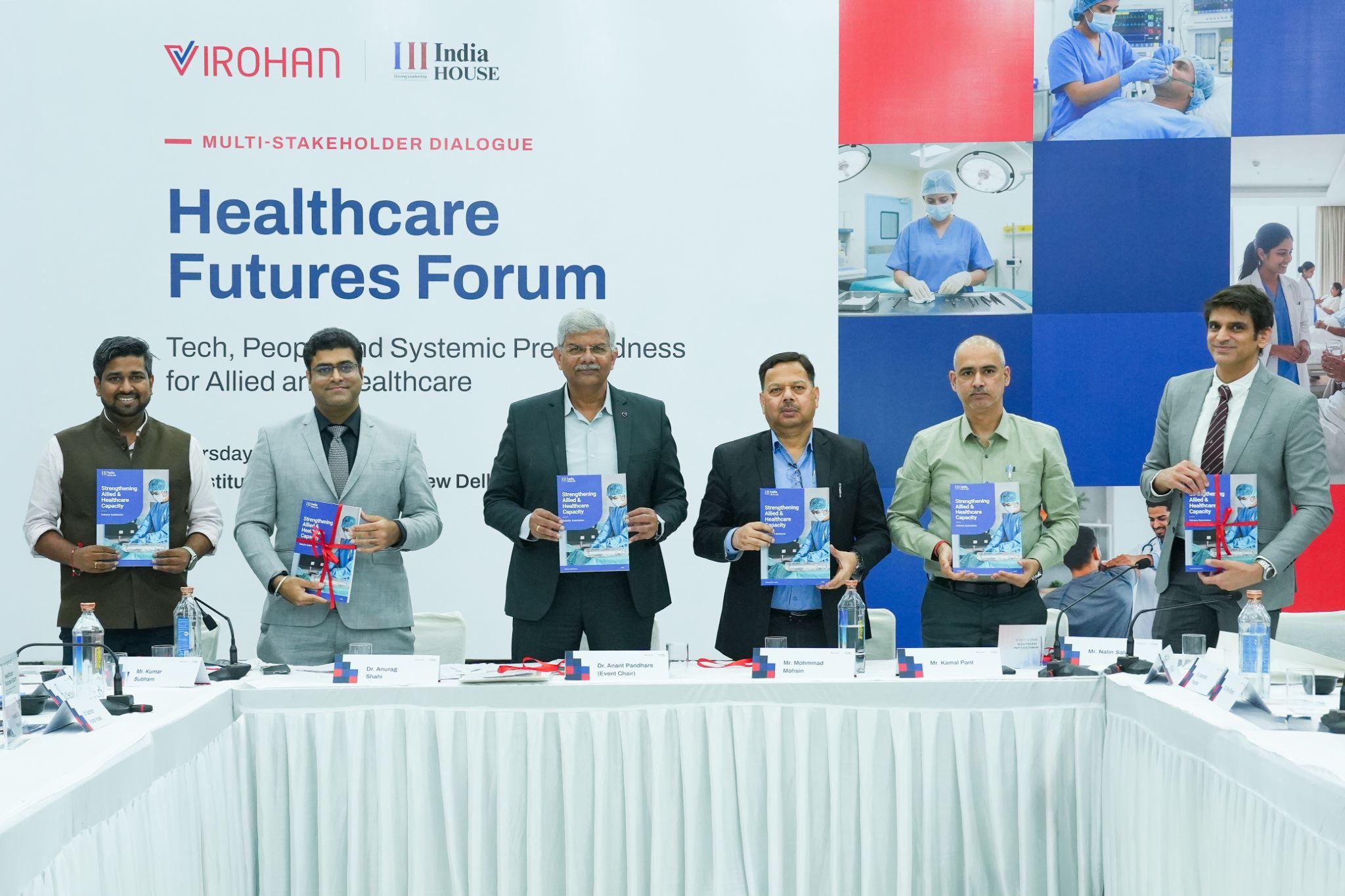
New Delhi, 21 October 2026: India House, a New Delhi-based think-and-do tank, launched the second edition of its report, “Strengthening Allied & Healthcare Capacity: Industry Submission”, at the Healthcare Futures Forum held on 8 October 2026 at the Constitution Club of India, New Delhi.
The report was launched in the presence of senior government officials, institutional leaders and regulatory representatives, including Mr Mohammad Mohsin, IAS, Additional Chief Secretary, Medical Education, Government of Karnataka; Dr Anant Pandhare, President, AIIMS Nagpur; and Dr Kamal Pant, Chairperson, Uttar Pradesh State Allied and Healthcare Council.
The forum brought together more than 50 experts, with participation from over 15 universities and academic institutions, more than 10 industry representatives from hospitals, healthcare chains and employers, and over four government and regulatory institutions, alongside industry associations and healthcare experts.
Building on the first edition launched in March 2026, the updated report documents progress in implementing the National Commission for Allied and Healthcare Professions (NCAHP) framework. It acknowledges measures taken by the Government of India and NCAHP, and presents revised recommendations addressing regulatory, institutional and workforce priorities in the context of evolving domestic and global healthcare needs.
The report highlights three significant developments since the first submission. The NCAHP circular dated 8 April 2026 provided interim arrangements for continuing existing courses, expanding student intake and commencing new programmes for Academic Year 2026–27. It also recognised clinical training through institutional facilities or formal partnerships with practising healthcare facilities, addressing a concern raised in the earlier submission. Curriculum corrigenda issued in March and May 2026 introduced greater flexibility in internship stipend provisions, enabling the respective State Allied and Healthcare Councils to determine stipend amounts.
Kumar Subham, Co-Founder and CEO of India House, emphasised that the next phase of reform must balance three priorities: maintaining continuity, expanding capacity and improving quality. He noted that the establishment of a national framework was an important milestone, and that its success would depend on translating policy intent into clear, workable institutional processes. Drawing on consultations with more than 50 institutions and experts, the report seeks to bring implementation-level perspectives into this dialogue.
While recognising the progress achieved, the updated report identifies priorities for expanding allied and healthcare capacity while preserving professional competency and patient safety. These include greater clarity in regulatory and state-level implementation, feasible infrastructure and faculty requirements, stronger clinical training arrangements, and clearer qualification and progression pathways for students and experienced professionals.
The report outlines a vision for a robust, accessible, and globally competitive allied and healthcare workforce by 2031, as a milestone towards Viksit Bharat 2047. It emphasises expanding quality training beyond metropolitan centres, strengthening collaboration between universities and healthcare providers, and developing employment pathways aligned with India’s evolving healthcare needs.
Through this updated submission, India House seeks to support constructive engagement among government, regulatory institutions, academia and industry, helping translate regulatory progress into stronger training capacity and a workforce equipped to deliver quality healthcare at scale.
Read the report: https://theindiahouse.org/heathcare-futures-forum/
About India House
India House is a Delhi-based think-and-do tank, co-founded by alumni and faculty of various IITs, dedicated to nurturing young changemakers and reimagining policy institutions for India.